
- sovasolar_admin
- Feb 10, 2026
- Uncategorized
- 0 Comments
India’s rapid solar adoption is backed by a growing domestic manufacturing ecosystem. But most buyers whether EPC contractors, industrial clients, or investors do not fully understand how a solar panel is actually made.
For businesses evaluating solar panel manufacturers in India, understanding the manufacturing process is critical to assessing quality, durability, and long-term performance.
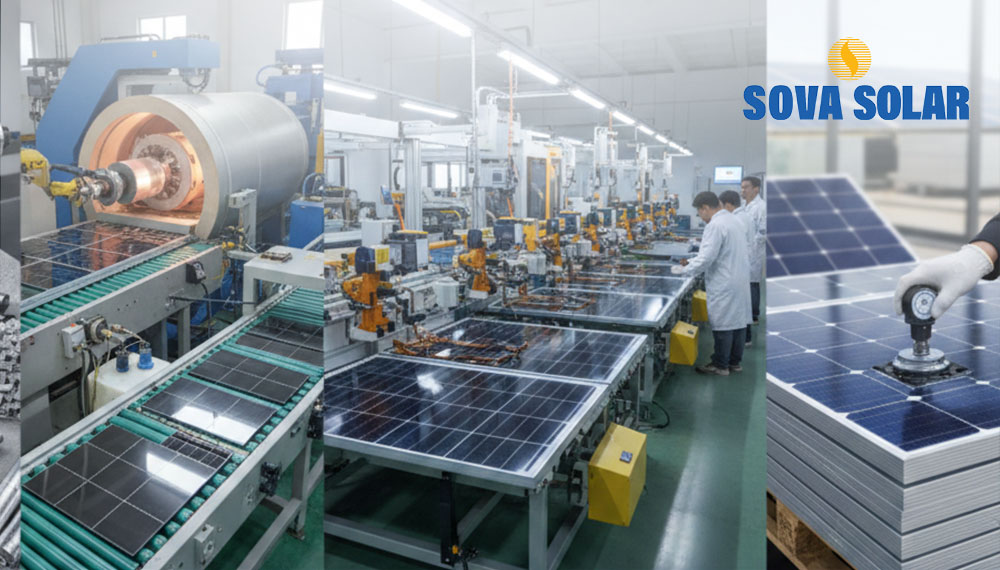
This guide explains the complete solar panel manufacturing journey from raw silicon to certified module.
Step 1: Polysilicon Production – The Foundation
Every solar panel begins with silicon, one of the most abundant elements on Earth.
Process:
- Quartz sand is refined at extremely high temperatures.
- Impurities are removed to produce high-purity polysilicon (99.9999% purity or higher).
- The purified material is formed into silicon ingots.
Why this matters:
The purity level directly impacts efficiency. Higher purity = better energy conversion performance.
Step 2: Ingot and Wafer Manufacturing
Ingot Formation
- Molten polysilicon is cooled and solidified into cylindrical (monocrystalline) or rectangular blocks.
- These are called ingots.
Wafer Cutting
- Ingots are sliced into ultra-thin wafers (around 150–200 microns thick).
- Diamond wire saws ensure precision and minimal material loss.
These wafers form the base of solar cells.
India’s leading solar power companies in India increasingly focus on improving wafer efficiency to compete globally.
Step 3: Solar Cell Fabrication
This is where electricity-generating capability is created.
Key Stages:
- Surface texturing
- Reduces reflection
- Improves light absorption
- Doping process
- Phosphorus is added to create an electric field
- Enables electron movement
- Anti-reflective coating
- Further increases absorption
- Metallization
- Silver and aluminum contacts are printed
- Enables current flow
- Firing and curing
- Contacts are permanently bonded
At this stage, the wafer becomes a functional solar cell.
Advanced technologies like TOPCon or HJT modify this stage to improve efficiency and reduce recombination losses.
Step 4: Cell Testing & Sorting
Each solar cell is tested for:
- Voltage output
- Current generation
- Efficiency rating
Cells are sorted based on performance to ensure uniform module assembly.
Inconsistent sorting leads to mismatch losses a major quality issue among low-grade manufacturers.
Reputed solar panel manufacturers in India implement strict EL (Electroluminescence) testing at this stage.
Step 5: Module Assembly
This is where individual cells become a full solar panel.
Assembly Process:
- Cell stringing
- Cells are soldered together in series
- Layer stacking
- Glass (front layer)
- EVA encapsulant
- Solar cells
- Back sheet
- Aluminum frame
- Lamination
- Vacuum lamination bonds layers permanently
- Framing and junction box installation
- Curing and sealing
The lamination process is critical. Poor lamination leads to moisture ingress and premature failure.
Step 6: Quality Testing & Certification
Before market release, modules undergo rigorous testing:
Mechanical Tests
- Load testing (wind & snow resistance)
- Frame strength testing
Environmental Tests
- Damp heat exposure
- Thermal cycling
- UV resistance
Electrical Tests
- Flash testing (output verification)
- Insulation resistance
- EL imaging (micro-crack detection)
Certifications typically include:
- IEC 61215
- IEC 61730
- BIS Certification
- MNRE compliance
Reliable solar power companies in India only source from certified facilities to ensure long-term project stability.
Step 7: Packaging & Logistics
Modules are:
- Carefully palletized
- Shock-protected
- Moisture sealed
Improper packaging can cause microcracks before installation affecting long-term performance.
Why Manufacturing Process Matters for Buyers
Many buyers compare only price per watt. That is a mistake.
You should evaluate:
- Cell technology (PERC, TOPCon, HJT)
- Degradation rate
- PID resistance
- Warranty backing
- Manufacturing traceability
Low-cost imports may save upfront money but increase:
- Degradation risk
- Replacement cost
- Insurance complications
Working with established solar panel manufacturers in India ensures traceability, compliance, and consistent supply.
Frequently Asked Questions (AEO Optimized)
How long does it take to manufacture a solar panel?
The full process from wafer to module assembly typically takes several days, depending on automation level and plant capacity.
What determines solar panel quality?
Silicon purity, cell technology, lamination quality, and certification standards.
Are Indian solar panels globally competitive?
Yes. With PLI schemes and advanced cell technologies, Indian manufacturers are increasingly meeting international efficiency and quality benchmarks.
Why do some panels degrade faster?
Poor material quality, weak encapsulation, or improper lamination can lead to higher degradation rates.
Final Takeaway
Solar panels are not just hardware they are engineered energy assets expected to perform for 25+ years.
Understanding the manufacturing process helps buyers:
- Evaluate supplier credibility
- Compare technologies correctly
- Reduce long-term project risk
As India strengthens its domestic renewable ecosystem, partnering with experienced solar panel manufacturers in India and reputable solar power companies in India ensures reliability, compliance, and long-term energy security.